
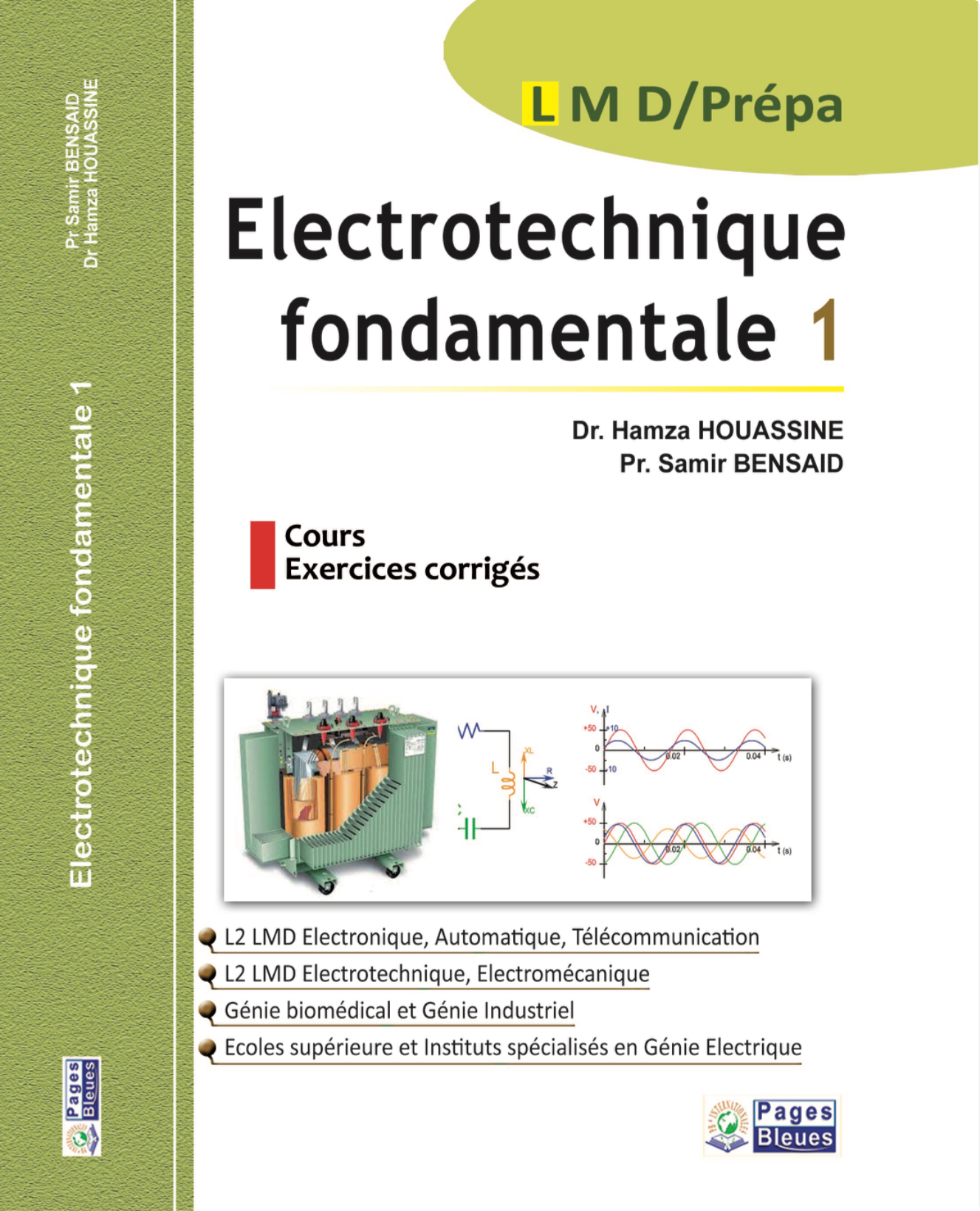
Fondamental Electrotechnics 1
This book, entitled “Fundamental Electrotechnics 1 - Courses and Exercises," is intended for second-year Bachelor’s degree students in Electronics, Electrical Engineering, Automation, Electromechanics, Telecommunications, Biomedical Engineering, and Industrial Engineering. It can also be used by students in schools and institutes specializing in Electrical Engineering. The book primarily covers the fundamentals of single-phase and three-phase electrical circuits, coupled coils and transformers, as well as an introduction to rotating machinery. The content of this book, presented in six chapters, is entirely based on the official national Bachelor's degree program for the aforementioned courses. In each chapter, we have made sure to present the core concepts of the course along with several application exercises that address all the fundamental principles related to the chapter’s content. The first chapter revisits complex numbers, a mathematical tool widely used in the analysis of electrical circuits in the sinusoidal alternating regime. The second chapter is dedicated to the study of the general laws of electricity, which will help the reader understand the concepts related to electricity in general, and electrical engineering in particular. The third chapter focuses on the study of electrical circuits in the alternating sine regime and the various types of power involved in both single-phase and three-phase alternating currents. In the fourth chapter, we delve into the study of magnetic circuits, which are a key component in electrical machines. Mastery of concepts related to magnetic circuits is essential for understanding the physical phenomena involved in the operation of all electrical machines. The fifth chapter is devoted to a general study of the transformer, a machine widely used in the transmission and distribution of electrical energy. The final chapter provides an overview of various types of rotating electrical machines. It highlights their different operating modes to help electrical engineering students understand the fundamental principles behind these electromagnetic energy converters.
Autres livres de : Pr. Samir BENSAID Dr. Hamza HOUASSINE
Livres dans la même catégorie
Avis des lecteurs
Aucun avis pour le moment.