← Retour

Probability and statistics

par:
Disponible
Pages 134
Dimensions 16*23,5
Publication 2024-02-19
Éditeur —
Papier : 950.00 DA Numérique: 475.00 DA

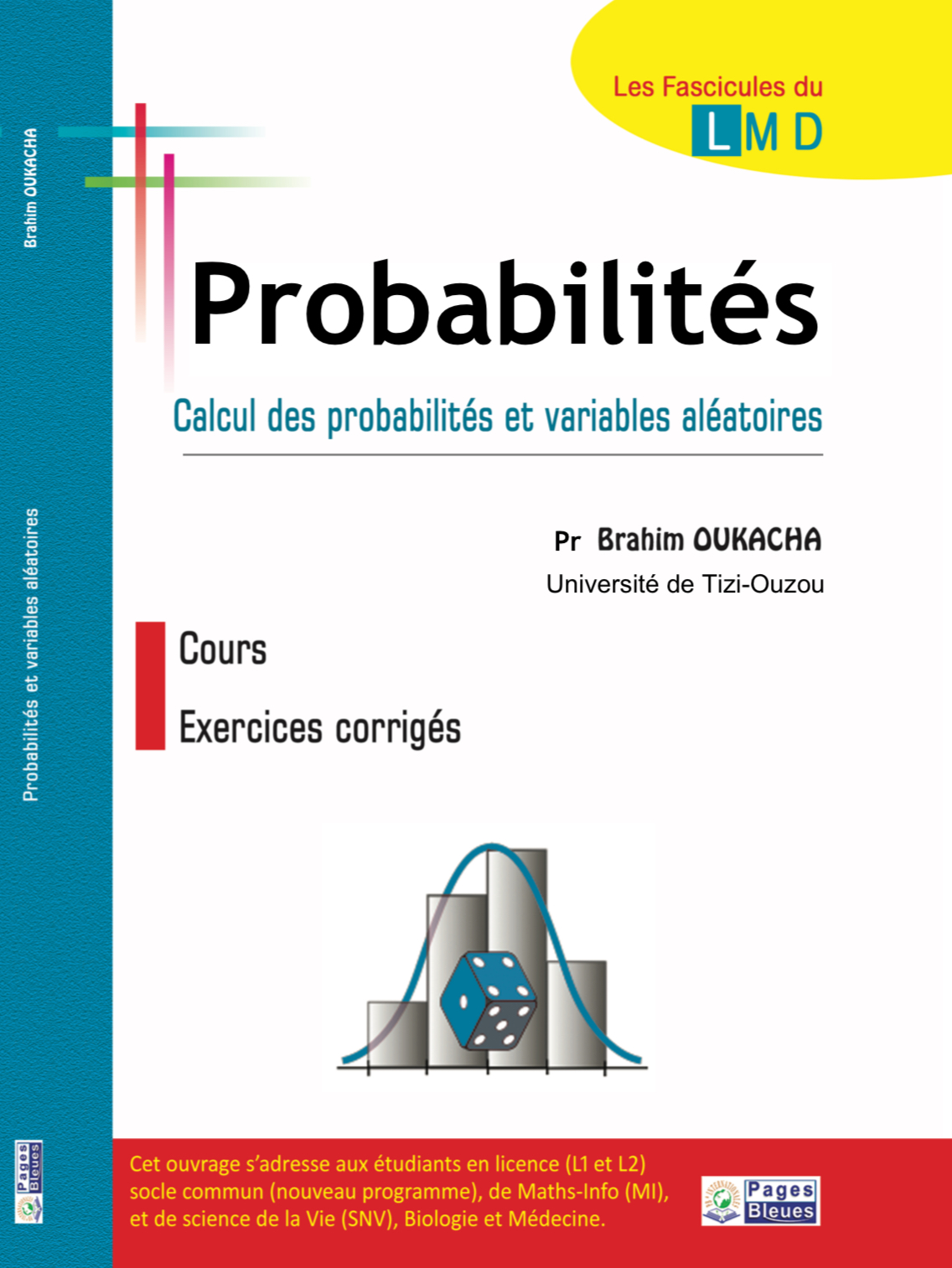
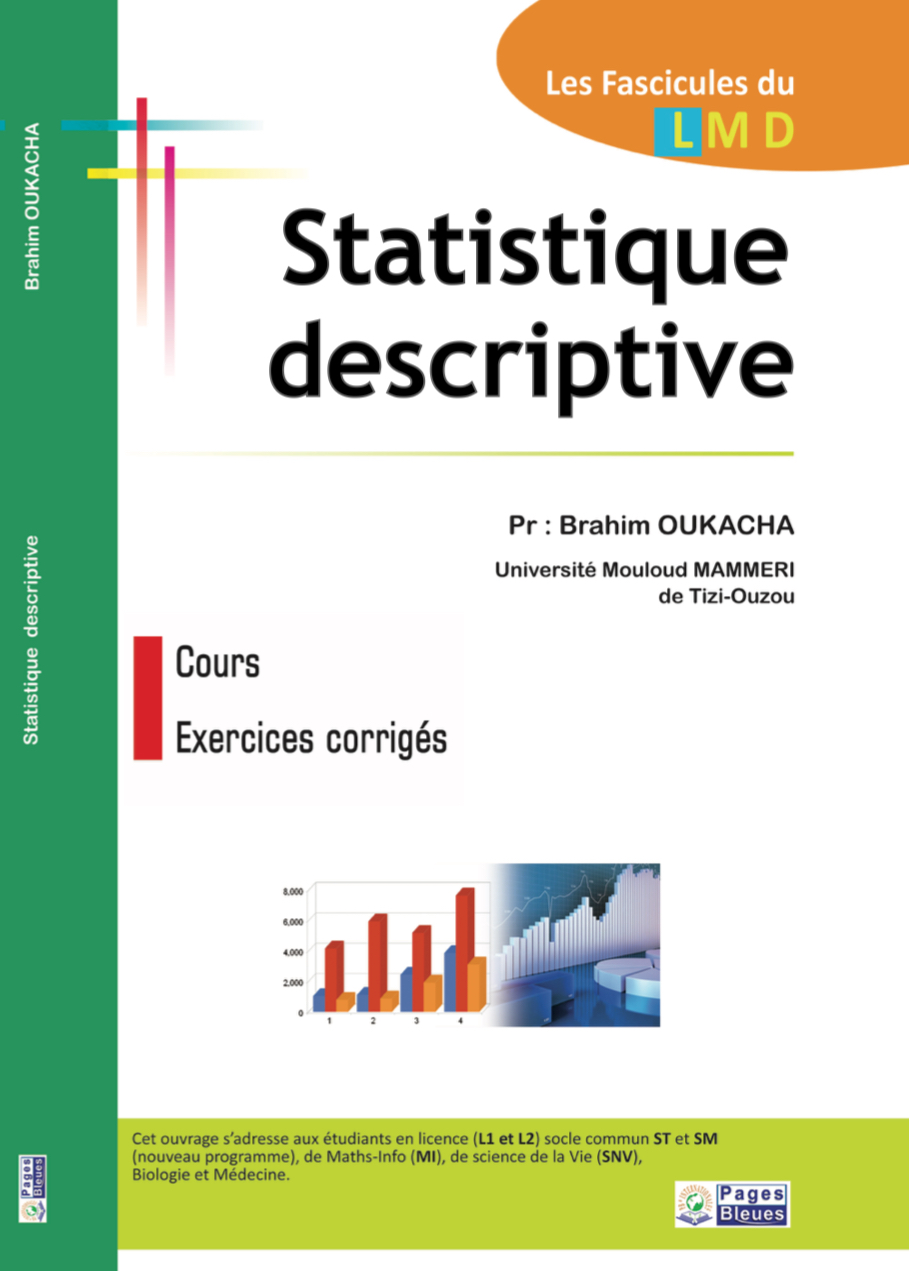
THE purpose of this Booklet is to provide an introduction to the general principles of probability and statistics, which may be of interest to anyone interested in this discipline, regardless of their specialization. It may be of particular interest as a reference for second-year students in civil engineering, mechanical engineering, process engineering, control systems, electromechan- ical and electronics. Probability is one of the modules taught by numerous researchers, as most sciences rely on probabilities for studies; results are often based on probabilities that are primarily governed by laws, and each phe- nomenon has a specific law. On the other hand, statistics plays an increasingly important role in almost all aspects of human behavior. Initially developed in public affairs, which explains its name, its influence has now expanded to agriculture, medicine, biology, physics, and other branches of science and technology. At the beginning of each chapter, we provide important definitions and theorems, and then we offer some exercises with solutions. The first part of the Booklet is devoted to probability, which includes combinatorial analysis, probability calculations, and random variables. The second part focuses on statistics, we have two chapters: statistical series with one variable and statisti- cal series with two variables. First, we cover the terminology of statistics, and then we offer some exercises with solutions. Through this content, the main objective is to understand the definitions and theorems, and the student will also be able to study probability and statistical models.

Afficher la table des matières
I Probability
1 Combinatorial analysis
1 Arrangement
1.1 Arrangement with repetition
1.2 Arrangement without repetition
2 Permutation
2.1 Permutation without repetition
2.2 Permutation with repetition
3 Combination
3.1 Combination without repetition
3.2 Combination with repetition
4 Exercices
2 Introduction to Probability, Conditioning, and Independence
1 Introduction to Probability
1.1 Algebra of events
1.2 Definitions
1.3 Probability Spaces
1.4 General Theorems of Probability
2 Conditioning and independence
2.1 Conditioning
2.2 Independence
3 Bayes’ formula
4 Exercices
3 Random Variables and Standard Probability Distributions
1 Random Variables
1.1 Various types of random variables
2 Common Probability Distributions( Usual Probability Laws) .
2.1 Common Discrete Probability Distributions
2.2 Common continuous probability distributions ( Usuel Continuous Probability Laws)
3 Exercices
II Statistics
4 Statistical Series with One Variable
1 Basic Definitions
2 Measures of Central Tendency
2.1 The Mean
2.2 The mode
2.3 The Median
3 Graphical Representations
3.1 Case of discrete variables
3.2 Case of continuous variables
3.3 Case of qualitative variables:
4 Positional Characteristics
5 Measures of Dispersion
6 Shape Characteristics
6.1 Asymmetry coefficient
6.2 Kurtosis Coefficient
7 Statistical Tables
8 Exercices
5 Statistical Series with Two Variables
1 Data Tables (Contingency Table) and Scatterplots
2 Marginal Distributions, Conditional Distributions and Co-variance
2.1 Marginal Distributions
2.2 Marginal Frequencies
2.3 Marginal Means and Marginal Variances
2.4 Conditional Distributions
2.5 Conditional Means and Conditional Variances
2.6 Covariance
3 Linear correlation coefficient
4 Regression Line and Mayer’s Line
4.1 Regression Line
4.2 Mayer’s Line (or Method of Mean Points)
5 Regression curves, regression corridor, and correlation ratio
5.1 Regression curves
5.2 Correlation Ratio
6 Functional Adjustment
6.1 Power adjustment
6.2 Exponential adjustment
7 Exercices
8 Annex1: Solved Exams
9 Annex2: Termilogy
Bibliography

Autres livres de :

Avis des lecteurs

Aucun avis pour le moment.