
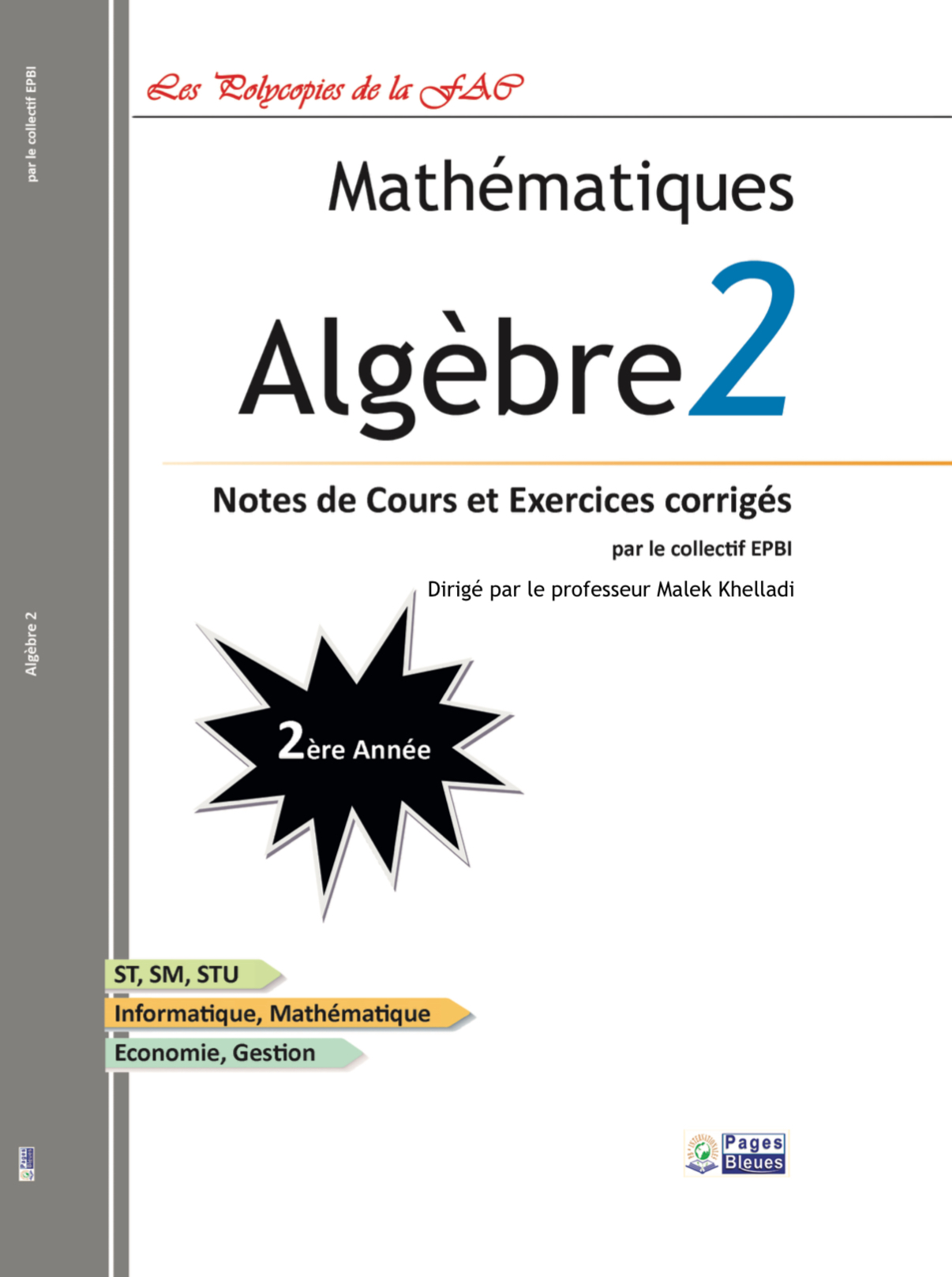
Mathematics : Algebra 2
This Algebra 2 textbook covers linear algebra, and is the continuation of the algebra curriculum in the first year of university and higher education programs in the fields of science, technology, computer science, and economics. It is an essential tool for all branches of applied mathematics, especially when it comes to modeling and numerically solving problems from various fields such as physical or mechanical sciences, life sciences, chemistry, economics, engineering sciences, etc. Linear systems play a key role in many application contexts as they form the computational basis of linear algebra. They also allow for the treatment of a large portion of the finite-dimensional linear algebra theory. Linear algebra is widely used in physics, computer science, engineering, statistics, economics, and many other fields for modeling and solving problems involving vector quantities or systems of linear equations. It is an essential tool for the analysis and resolution of various mathematical and scientific problems. Linear algebra mainly concerns the following domains: 1. Pure mathematics: linear algebra is a branch of mathematics that studies vectors, vector spaces, linear transformations, systems of linear equations, matrices, and determinants. 2. Engineering sciences: linear algebra is widely used in engineering sciences to model and solve complex mathematical problems in physics, computer science, signal processing, statistics, economics, etc. 3. Life sciences: linear algebra is also used in life sciences to model biological, ecological, medical phenomena, etc. 4. Artificial intelligence and machine learning: linear algebra is essential for data manipulation and solving complex problems in artificial intelligence and machine learning. This textbook covers the curriculum of the second semester, which includes: • Vector space → (Chapter 3) • Linear applications → (Chapter 4) • Matrices → (Chapter 1) • Systems of linear equations → (Chapter 2) The chapters order can change based on what you're studying (like tech, computers, or business). Your teacher can choose which chapter to teach first because each chapter is on its own
Autres livres de : Khelladi et Collectif EPBI
Livres dans la même catégorie





Avis des lecteurs
Aucun avis pour le moment.