
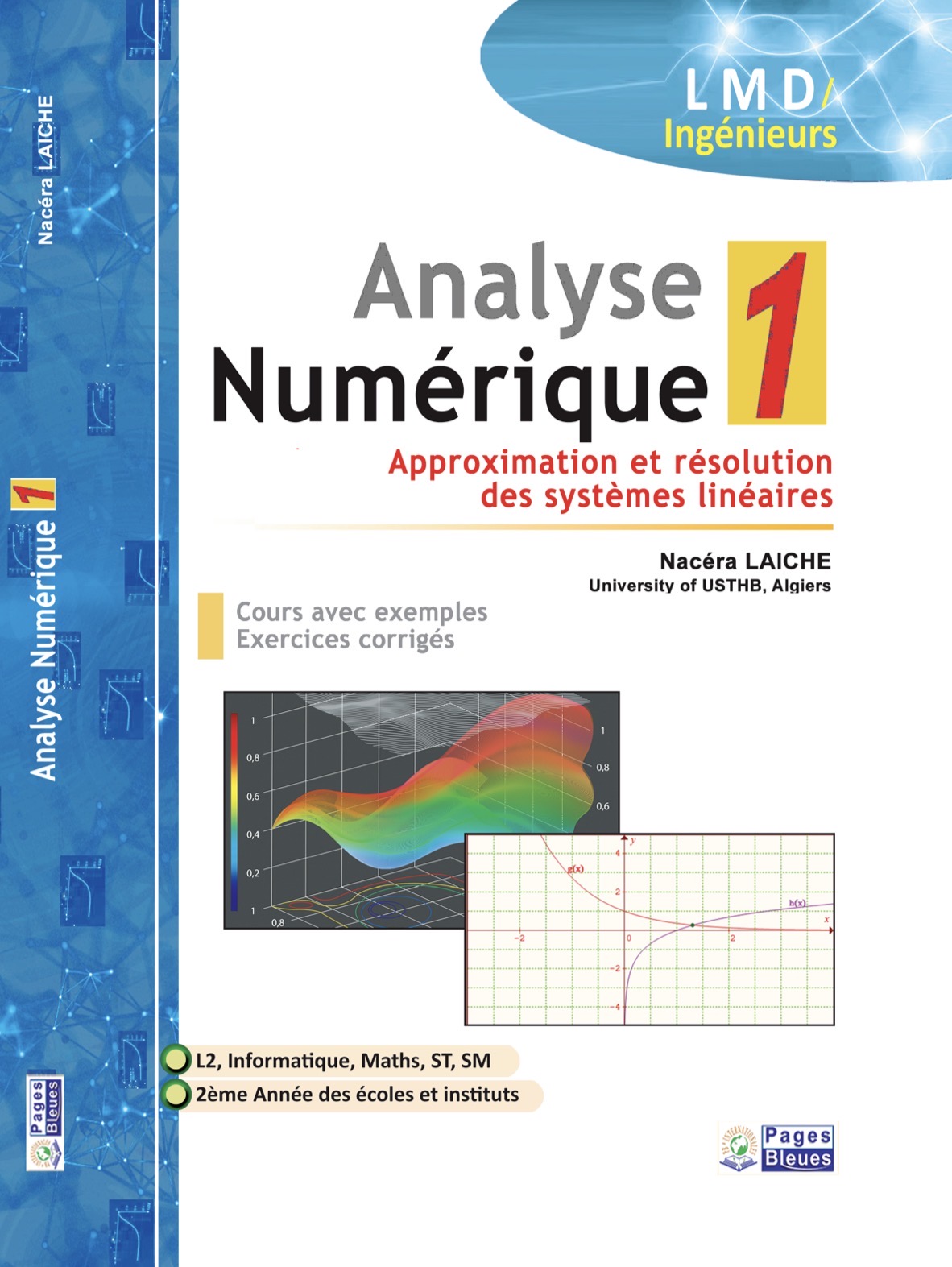
Numerical 1 Analysis : Nonlinear equations and Linear systems
This book is designed for second-year undergraduate students in Computer Science, specializing in Information Systems and Software Engineering (ISIL) and Academic (ACAD) tracks as well as engineering students. Its objective is to present fundamental numerical computation algorithms to familiarize students with analysis and modeling techniques, enabling them to design programs with a solid theoretical foundation. It is also aimed at mathematics students and anyone interested in or needing a strong background in algorithms for solving modeling problems. Numerical analysis consists of developing numerical methods or algorithms to solve mathematical problems originating from the modeling of real-world phenomena or arising in research and applications. Generally, these solutions are computed using calculating devices namely computers or calculators and software tools. Among the latter are Mathematica, Scilab, Matlab, C++, Maple, Python, etc. In this new edition of Numerical analysis, three core chapters are addressed: the approximate solution of real nonlinear equations of the form 𝑓(𝑥) = 0, the exact solution of square linear systems via direct methods (algorithms), and the approximate solution of linear systems via iterative (indirect) methods. An additional introductory chapter covers the basic concepts of errors in numerical analysis, an essential topic in the field of numerical analysis. At the end of each chapter, various types of exercises of varying difficulty levels illustrating different resolution techniques are provided, followed by detailed solutions. This book also includes sample examination papers with detailed solutions and a bibliography to further enrich its content. It should be noted that this book may not contain all the theoretical proof given the target field of study, although many proofs are presented in detail to facilitate the understanding of the concepts and results. Readers seeking further proofs and details may consult the references in the bibliography or contact me directly. Finally, I would like to express my gratitude to all the people who have contacted me to report errors or to send their thanks, whether teachers or students. I hope this new edition will continue to bring pleasure and interest to both students and colleagues. Despite several careful proofreading, typos or minor unintentional errors may remain. If you find any, please report them by email to the address mentioned below. Furthermore, if you have any comments or suggestions to improve future editions of this work, please do not hesitate to contact me; I would be very grateful. Nacéra Laiche nlaiche@usthb.dz. September 2026, USTHB-FI
Autres livres de : N Laiche
Livres dans la même catégorie






Avis des lecteurs
Aucun avis pour le moment.