
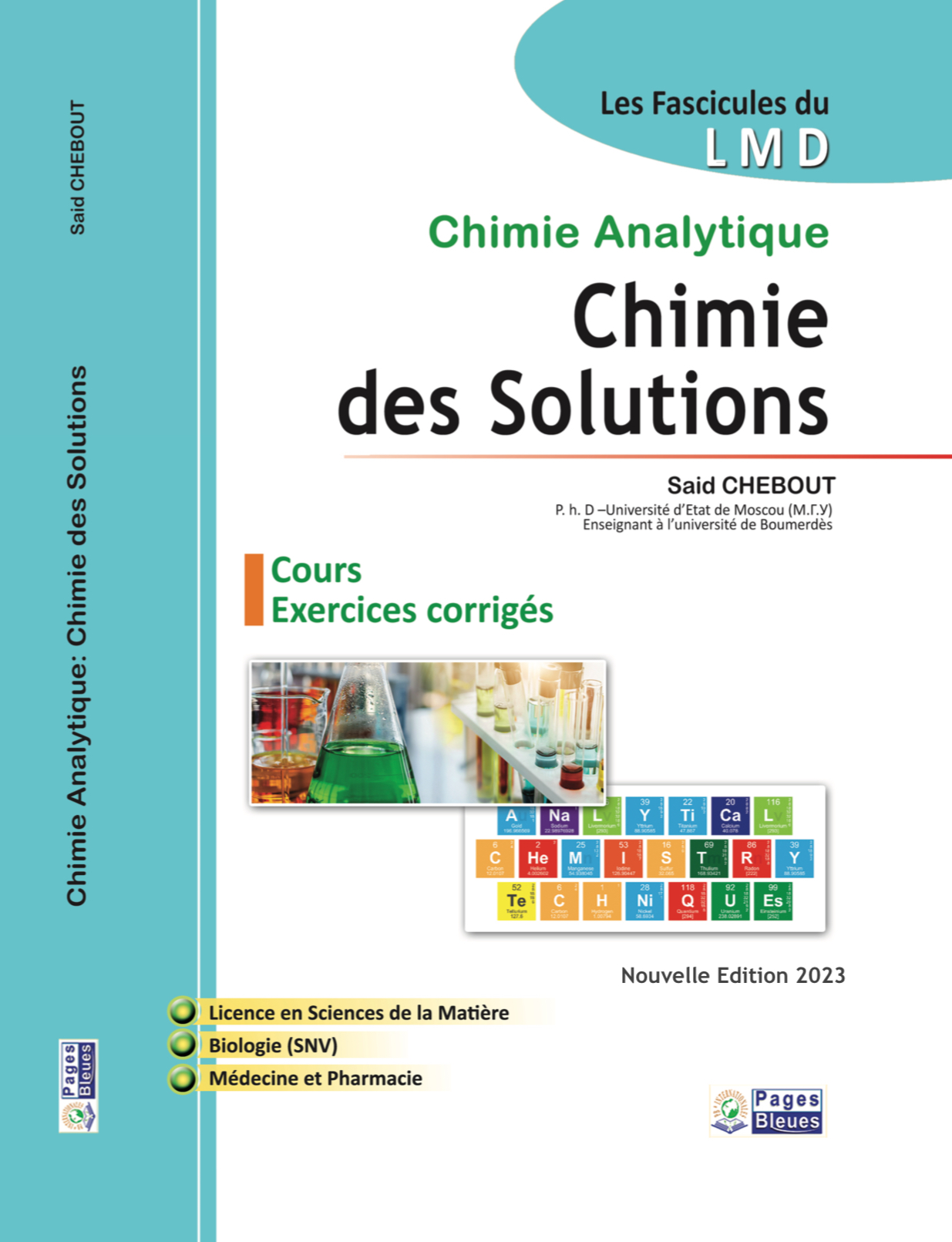
Analytical Chemistry Solution Chemistry
This third edition has been corrected, improved by adding marked exams in such a way that the reader can: Assimilate and understand the chemistry of solutions while self-assessing. Help the reader acquire organized and structured knowledge. Make the reader active by allowing him to evaluate his work thanks to the tutorials accompanied by their detailed answers. Solution chemistry is the branch of chemistry that is concerned with all reactions in solution. An important field in this branch is the study of acid-base reactions in aqueous solution. This book brings together the knowledge essential to the understanding of solution reactions, which are the fundamental principles of many methods used in the field of pharmaceutical analysis as well as in that of chemistry or biology. The basic theoretical training in solution chemistry will allow a better understanding of the phenomena encountered in the laboratory. These dosing techniques have the advantage of being easy and quick to implement. The equipment necessary for their realization is economically affordable. In addition to the educational aspect, they are commonly used in industry for routine checks such as checking the concentration of a surface treatment bath, fine chemical and the environment. This manual is the result of the experience acquired during several years of teaching. It is therefore intended for chemistry students, but it can also be used with profit by those in the first year of medicine, pharmacy, biology and the undergraduate of the Faculty of Science. The exercises are treated clearly and detailed to be well assimilated by the students. The chemistry of solutions encompasses a large number of topics, the interest of which is most often the determination of a compound in a liquid medium. In this course, we will only be interested in aqueous solutions. The classic assay methods used in this field of chemistry are: pH - metry, oxidation - reduction, conductimetry etc... After a reminder of the key points in the first two chapters (classification and nomenclature of mineral compounds), the book develops in five main chapters: ionic and acid-base equilibria, complexation equilibria, heterogeneous equilibria and oxidation-reduction reactions. Each chapter is followed by a series of exercises and problems.
Autres livres de : S Chebout
Livres dans la même catégorie
Avis des lecteurs
Aucun avis pour le moment.