← Retour

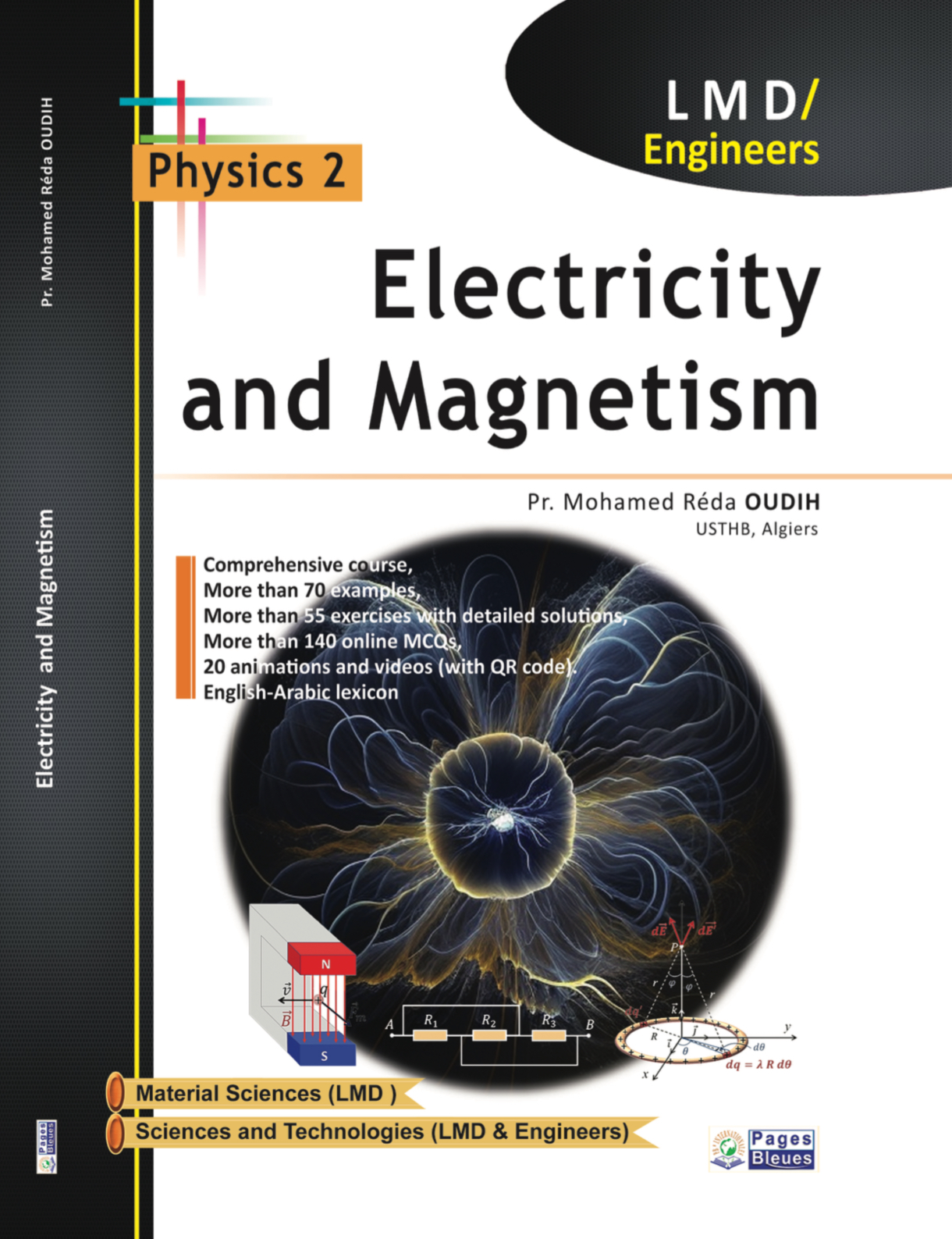
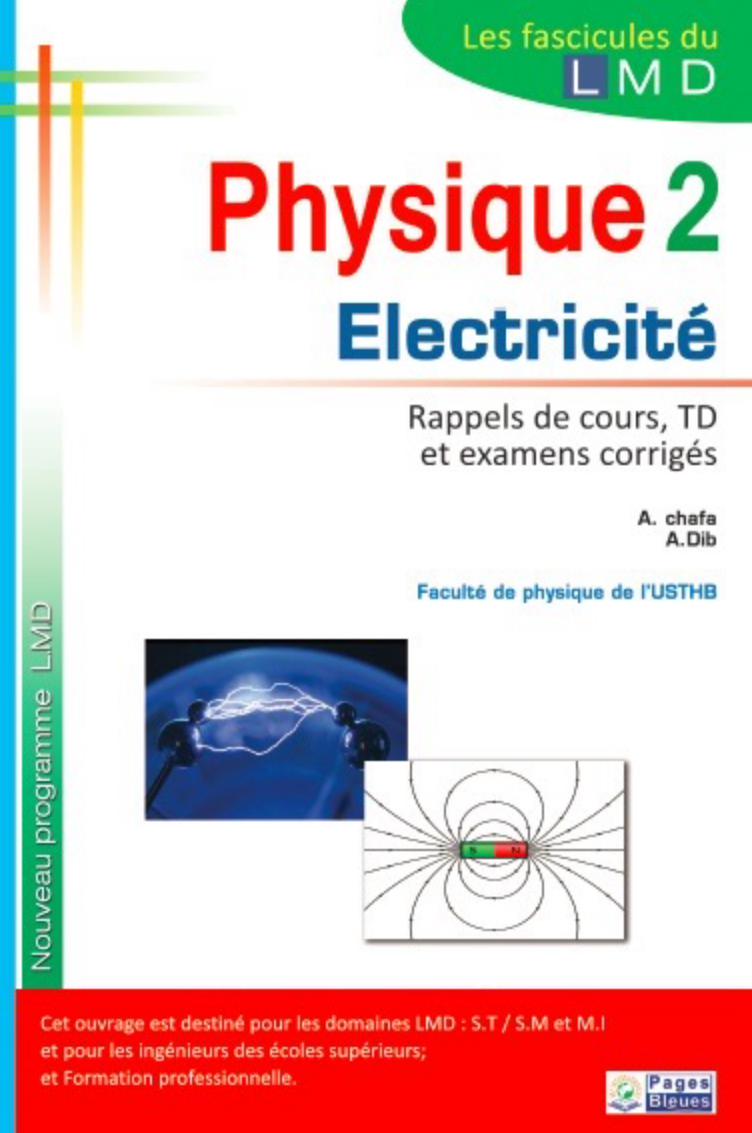
Physics 2 Electricity

par: Bourahla
Disponible
Pages 210
Dimensions 16*23,5
Publication 2024-01-20
Éditeur —
Papier : 1 200.00 DA Numérique: 600.00 DA

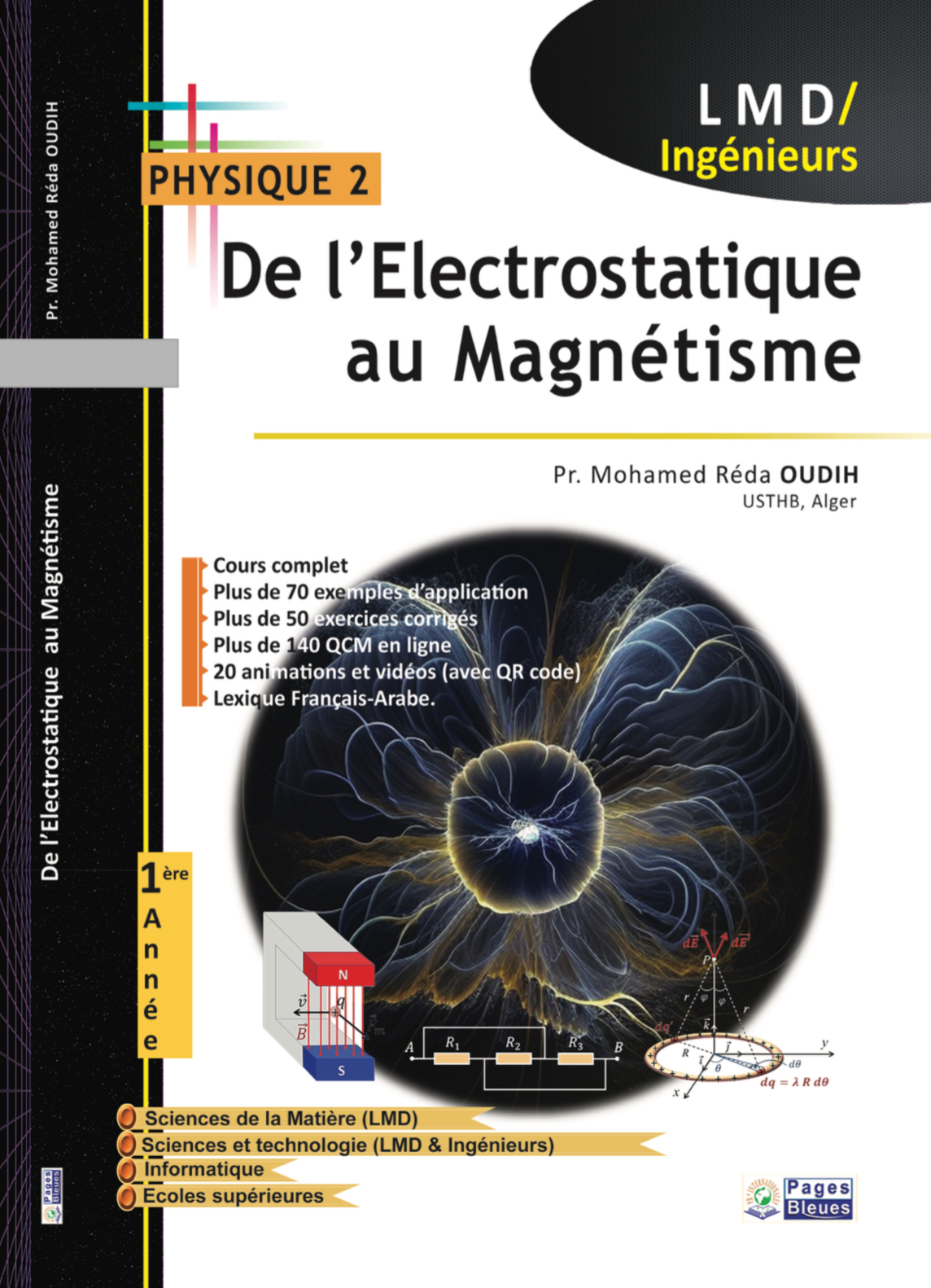
This english edition of the Physics 2 course and corrected exercises, was supplemented by magnetostatics. The manual is aimed at undergraduate LMD (L1) and Engineers students in the “material sciences” and “science and technologies” fields of Algerian universities and major schools. It will allow for L1 students to prepare and follow their course in the “Physics” teaching unit. 2” in accordance with the official program. It is made up of three parts: electrostatic, electrokinetic and magnetostatic. The first chapter is an introduction to electrostatics (stationary or very slowly moving electric charges). Some definitions relating to electrification phenomena and the classification of materials are recalled. In chapter two, the different physical states that characterize the space around immobile electric charges are described, in the case of point charges and continuous charge distributions. Conductors constitute a special case of materials, where electrification is not localized. They are studied in the steady state in chapter three. Chapters four & five are devoted to electrokinetics (moving charges). We will discuss how to calculate the physical quantities due to the movement of electric charges. This will be followed by the application of electricity conservation laws on electrical circuits and networks. The basic notions that describe magnetostatics are grouped together in the sixth chapter. The seventh and final chapter is the subject of magnetic induction. It is noted that the physical phenomena that will be studied (in higher years) require prerequisites in magnetostatics. I recommend that students consult the cited references, as they contain other important details.

Afficher la table des matières
Chapter 1: Electrical interaction
Introduction
1. General concepts
2. Electrification methods
3. Coulomb's law
 Exercise series n° 1
 Answer key to series n° 1
Chapter 2: Electric field and potential
1. Concept of electric field
2. Expression of the electric field
3. Electrostatic potential
4. Characteristics of the electrical space
5. Electrostatic energy
6. Electrostatic flow and Gauss's theorem
7. Electric field and potential of an electric dipole
 Exercise series n° 2
 Answer key to series n° 2
Chapter 3: Conductors in electrostatic equilibrium
1. Definition and properties of conductors in equilibrium
2. Influence phenomena
3. Capacitors
 Exercise series n° 3
 Answer key to series n° 3
Chapter 4: Electrical Conduction
1. Introduction to electric current
2. Ohm's law
3. Resistance association
4. Joule's law
5. Charging and discharging a capacitor
 Exercise series n° 4
 Answer key to series n° 4
Chapter 5: Analysis of electrical circuits and networks
1. Definitions: generators and receivers
2. Electrical energy received or transferred by a generator
3. Efficiency of a generator, a receiver
4. Linear networks in continuous mode
 Exercise series n° 5
 Answer key to series n° 5
Chapter 6: Magnetostatics
1. Magnetic and magnetostatic field
2. Magnetic forces
3. Circulation of the field and Ampère's theorem
4. Action of the magnetic field on a closed circuit
 Exercise series n° 6
 Answer key to series n° 6
Chapter 7: Magnetic induction 191
Introduction
1. Magnetic induction field flux
2. Faraday's law of induction
3. Lenz's law
4. Self-induction
5. Electric coils
6. Introduction to electromagnetic waves
 Exercise series n° 7
 Answer key to series n° 7
References

Avis des lecteurs

Aucun avis pour le moment.