← Retour

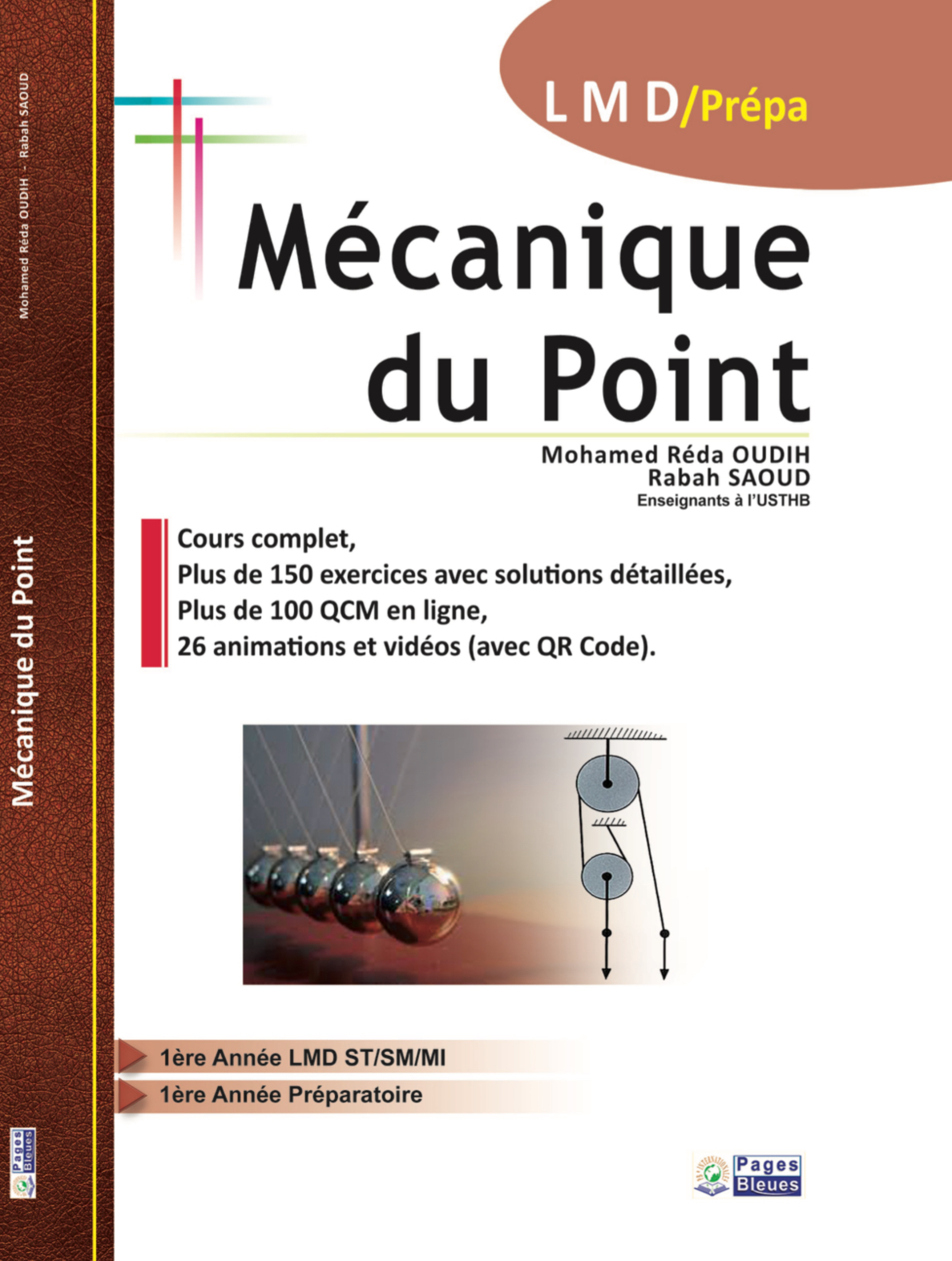
Physics : Mechanics of material point

par: Oudih & Saoud
Disponible
Pages 310
Dimensions 19*27
Publication 2023-09-22
Éditeur —
Papier : 1 900.00 DA Numérique: 950.00 DA

General Presentation This book is the result of many years of teaching experience acquired by the authors during lectures and tutorials in mechanics. It has been written with the aim of presenting the basic concepts and principles of mechanics in the clearest and simplest form possible without being imprecise. This work covers the entire first-year mechanics program of the SM and ST fields. The objectives of this book are: • Make mechanics accessible to students from different fields while taking into account their different backgrounds. • Provide students as well as young teachers with a solid foundation to help them fill in certain gaps. • Make physics attractive by showing the relevance and interest of mechanics with examples of modern applications in both science, technology and everyday life. • Teach students a writing style and instill in them a problem-solving method through detailed solutions to examples and exercises. Book Structure Course Each chapter begins with a richly illustrated course section with highlighted essential laws and formulas to draw attention to their importance. Strategy To promote reader autonomy, we have included problem-solving strategies in this book. These strategies teach the reader how to approach specific problems by following specific steps. Examples Each new concept is immediately followed by one or two examples. These are application exercises illustrated in a realistic or schematic way to facilitate easy understanding of problem-solving related to the concept. Remarks R Remarks are inserted at appropriate places to provide additional information or draw attention to errors to avoid. Sidebars and Footnotes Sidebars and footnotes provide historical notes or illustrate the usefulness of the concept introduced in the course by providing applications in various fields. Animations One of the unique features of this book is its links to powerful animations on the internet. These animations allow readers to interact with physical concepts. Videos The book also links to YouTube videos related to the concepts just introduced

Afficher la table des matières
1 Mathematics and Measurements
1.1 Scalar
1.2 Vector
1.2.1 Magnitude of a Vector
1.2.2 Components of a Vector
1.2.3 Equality of Vectors
1.2.4 Operations on Vectors
1.3 Trigonometry
1.3.1 Properties
1.3.2 Trigonometric Relationships
1.4 Dimensional Analysis
1.4.1 Dimension of a Physical Quantity
1.4.2 Dimensionally Independent Quantities
1.4.3 Dimensional Equation
1.4.4 Applications of Dimensional Analysis
1.5 Units and Unit Systems
1.5.1 History
1.5.2 SI Base Units
1.5.3 SI Derived Units
1.6 Measurement Errors and Uncertainties
1.6.1 Measurement Errors
1.6.2 Uncertainty
1.7 Summary
1.8 Exercises
1.9 Solutions
2 Kinematics
2.1 Introduction
2.1.1 Reference Frame
2.1.2 Choice of a Time Reference and a Coordinate System
2.1.3 Trajectory
2.2 Rectilinear Motion
2.2.1 Position
2.2.2 Velocity
2.2.3 Acceleration
2.2.4 Particular cases
2.2.5 Practical Relation
2.3 Motion in Space
2.3.1 Position
2.3.2 Velocity
2.3.3 Acceleration
2.4 Study of Motion in Different Coordinate Systems
2.4.1 Cartesian Coordinates
2.4.2 Intrinsic Coordinates
2.4.3 Polar Coordinates
2.4.4 Cylindrical Coordinates
2.4.5 Spherical Coordinates
2.5 Particular Motions
2.5.1 Projectile Motion
2.5.2 Circular Motion
2.6 Change of Reference Frame: Relative Motion
2.6.1 Relationship between Position Vectors
2.6.2 Composition of Velocities
2.6.3 Composition of Accelerations
2.7 Summary
2.8 Exercises
2.9 Solutions
3 Dynamics
3.1 Mechanical System
3.2 Notion of Force
3.2.1 Internal Force
3.2.2 External Forces
3.3 Isolated Body
3.4 Inertia
3.4.1 Principle of Inertia
3.4.2 Inertial Reference Frame
3.4.3 Concept of Mass
3.5 Momentum
3.5.1 Conservation of Momentum
3.6 Newton's Laws of Motion
3.6.1 Newton's First Law: Law of Inertia
3.6.2 Newton's Second Law: Fundamental Principle of Dynamics
3.6.3 Newton's Third Law: Law of Action and Reaction
3.7 Force, Momentum and Impulse
3.8 Common Forces
3.8.1 Gravitational Force
3.8.2 Weight
3.8.3 Tension in a Rope
3.8.4 Spring Tension
3.8.5 Contact Forces in Solids
3.8.6 Drag forces
3.8.7 Archimedes' Principle
3.9 Angular Momentum
3.9.1 Definition
3.9.2 Angular Momentum Theorem
3.9.3 Central Force Motion
3.10 Summary
3.11 Exercises
3.12 Solutions
4 Work and Energy
4.1 Work
4.1.1 Work done by a Constant Force
4.1.2 Work - General Case
4.2 Power
4.3 Kinetic Energy
4.3.1 Definition
4.3.2 Kinetic Energy Theorem
4.4 Conservative Forces and Potential Energy
4.4.1 Conservative Forces
4.4.2 Potential Energy
4.4.3 Examples of Potential Energy
4.5 Mechanical Energy
4.5.1 Definition
4.5.2 Mechanical Energy Theorem
4.5.3 Conservative System and Motion
4.5.4 Equilibrium and Stability of Equilibrium
4.5.5 Discussion of Energy Curves
4.6 Summary
4.7 Exercises
4.8 Solutions
Appendices
A Greek Alphabet - Multiples and Submultiples
A.1 Greek Alphabet
A.2 Multiples and Submultiples
B Trigonometric Formulas
C Derivatives and Integrals
C.1 Derivatives
C.2 Integrals
D Coordinate Systems
D.1 Determination of Basis Vectors
D.2 Expression of the Displacement Vector
D.3 Expression of the Gradient
English – Arabic Lexicon
Bibliography
Index

Autres livres de : Oudih & Saoud

Avis des lecteurs

Aucun avis pour le moment.