← Retour

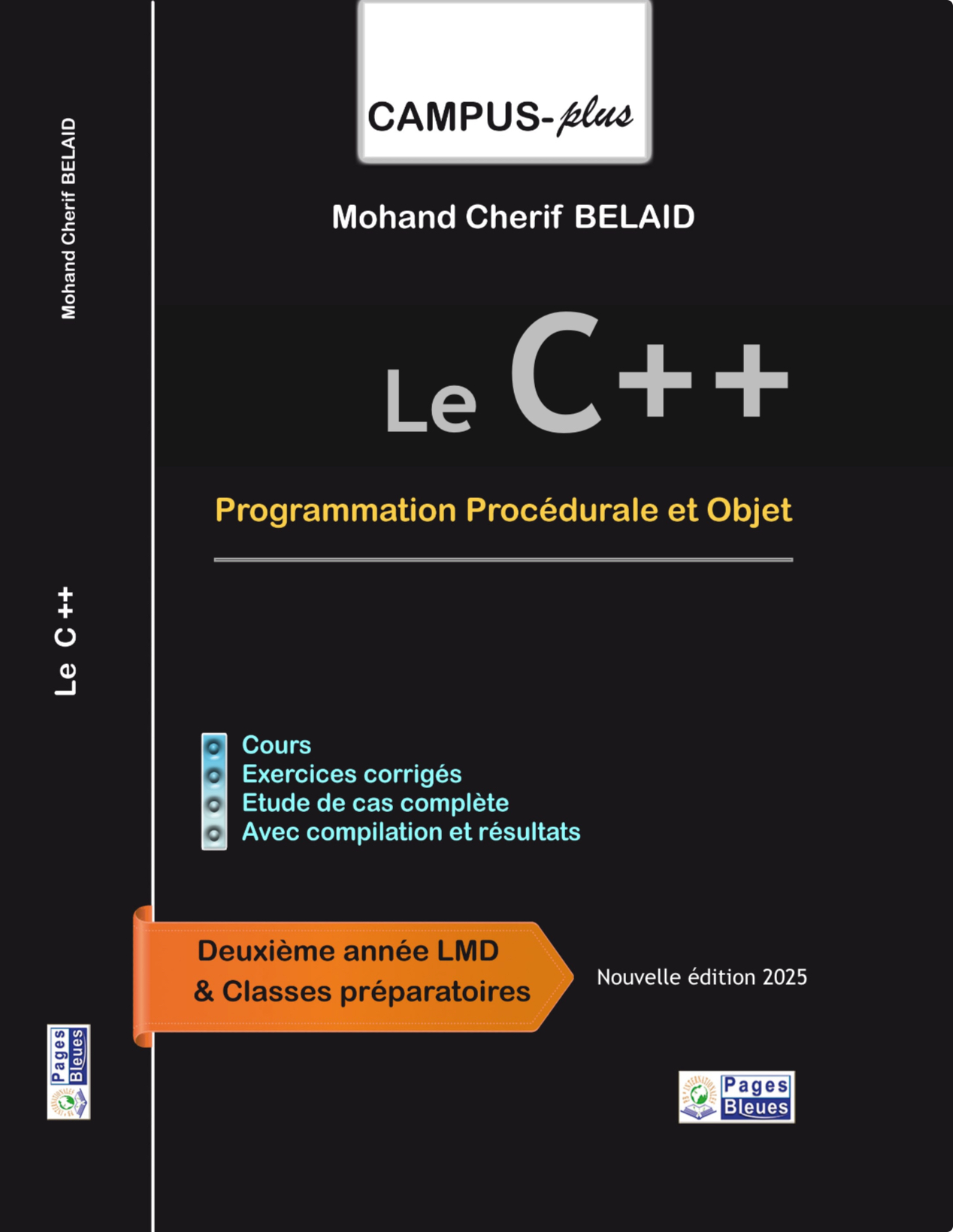
The C++ : Procedural and Object-Oriented Programming

par: Mc Belaid
Disponible
Pages 354
Dimensions 16*23,5
Publication 2026-10-15
Éditeur —
Papier : 1 650.00 DA Numérique: 825.00 DA

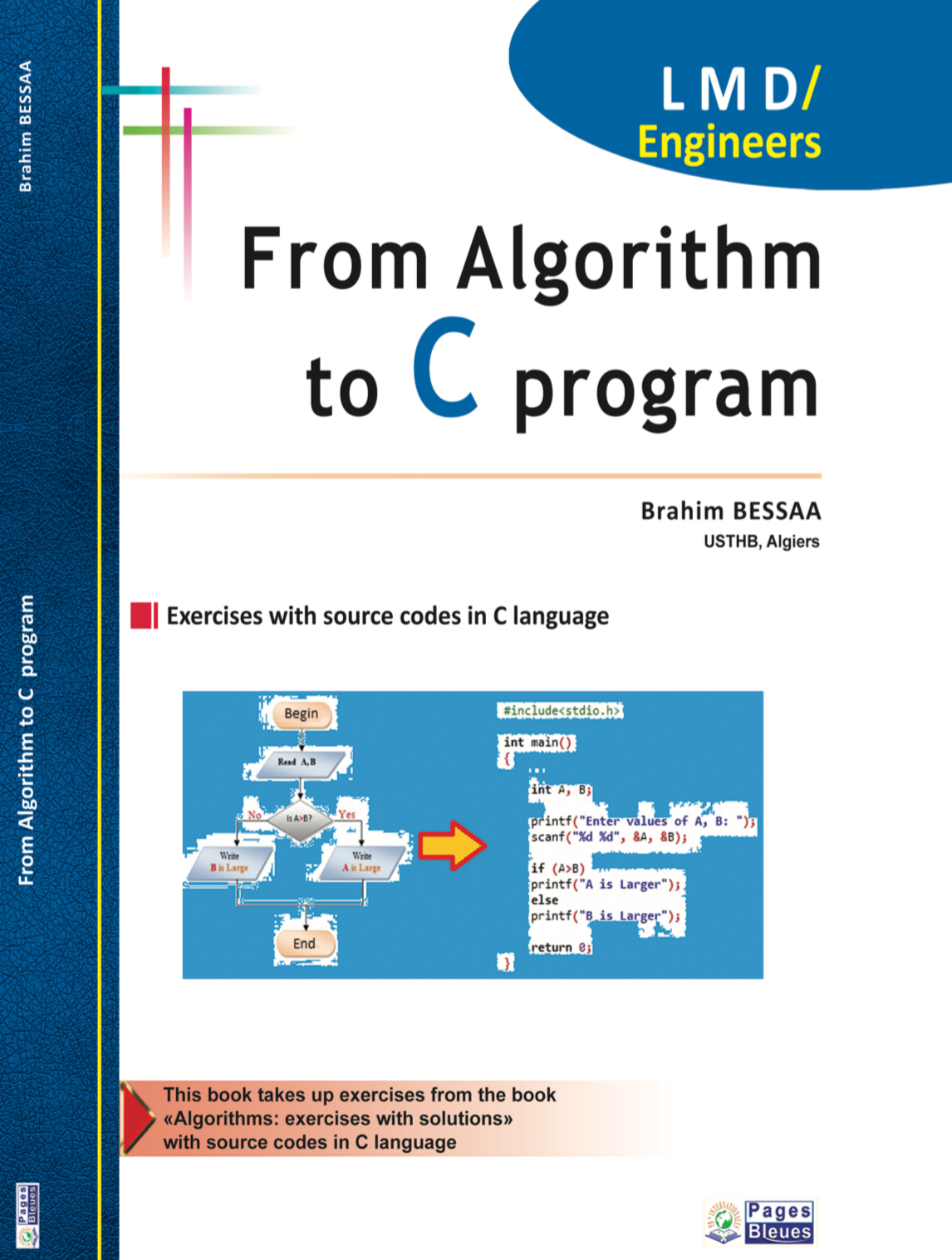
Many books dealing with the same subject flood university libraries, but few of them address the pedagogical difficulties related to programming and the choice of languages. This book aims to be a carefully crafted tool tailored to the needs of our students, in theory and in practice. This book is intended for anyone who wishes to learn procedural and object-oriented programming with the C++ language. The future university graduate (engineer or bachelor) must learn to use computing tools from the very beginning of their training. The C and C++ languages are highly valued by software development companies for scientific computing. C++ is a powerful language that inherits the power of C; it is flexible and portable, and it can easily interact with other languages such as JAVA, FORTRAN and others. In this book, we introduce the fundamental notions of procedural programming in the first part, that is, the C core of C++; then those of object-oriented programming, by adding the capabilities of the Object layer, in the second part. The book is therefore divided into two parts: the first part covers the tools of procedural programming through chapters 1 to 5. The second part covers object-oriented programming and its tools in C++, and spans five chapters, from 6 to 10. The book ends with a complete case study dealing with student records management, applying all the object-oriented notions studied in this book. The chapters include many application examples and exercises, all of which have been tested and compiled using two compilers: an installed CodeBlocks C++ and the online GDB Debugger for C++. The structure of the book allows for progressive teaching; teachers will have no difficulty using the book as a teaching tool for lectures and tutorials. -The publisher

Afficher la table des matières
Table of Contents
Overview
1- Versions of the C++ language
2- Should we learn C first before tackling C++?
3- Evolution of programming languages
4- The C++ language and procedural programming
5- The C++ language and object-oriented programming
Chapter 1: My first C++ program
1- Basic structure of a C++ program
2- My first program in the Borland C++ environment
3- Elements of a C++ program
4- Elementary data types
5- Assignments and algebraic expressions
6- Operators
Solved exercises
Chapter 2: Control structures (tests and loops)
1- Sequential processing
2- Conditional processing (if, else, switch)
3- Repetitive processing (While, For, do.. while)
4- The Break and Continue statements
5- General remarks on loops
Solved exercises
Chapter 3: Introduction to data structures
1- Data structures
2- Implementation of data in memory
3- Pointers in C++
4- Arrays (Vectors and Matrices)
Solved exercises
Chapter 4: Records, Enumerations and Unions
1- Enumerations
2- Records
3- Unions
Questions and solved exercises
Chapter 5: Functions
1- Declaring and defining a function
2- Local variables and global variables
3- Parameter passing
4- Inline functions
5- Function overloading
6- Default parameters
Solved exercises
Chapter 6: Concepts of Object-Oriented Programming (OOP)
1- The notion of object
2- The notion of class
3- Encapsulation
4- Inheritance
5- Polymorphism
6- Special methods: Constructor and Destructor
Questions and solved exercises
Chapter 7: Class, Object and Encapsulation in C++
1- Classes in C++
2- Private and public members of a class
3- Instantiating a class
4- Declaring and defining a class in C++
5- Encapsulation in C++
6- Friend classes and functions (friend)
7- Static members of a class
Questions and solved exercises
Chapter 8: Constructor and destructor
1- The Constructor in C++
2- The Destructor in C++
Questions and solved exercises
Chapter 9: Inheritance
1- Introduction
2- The principle of inheritance in C++
3- Inheritance and access rights
4- Multiple inheritance
Questions and solved exercises
Chapter 10: Polymorphism
1- Introduction
2- The principle of polymorphism in C++
3- Polymorphism with virtual functions
Questions and solved exercises
Complete solved case study
Bibliography

Avis des lecteurs

Aucun avis pour le moment.